Kristala
Kristala is a dark fantasy soulslike with an emphasis on acrobatic traversal, fluid combat, and deep exploration. This is a short highlight reel of player feedback on the level which I owned.
Engine: Unreal Engine 5.5
Genre: 3rd Person Soulslike ARPG
Team size: 40
Role: Level Designer
Tools: Blueprints, Git, Miro, ClickUp, Trello, Modeling Tools.


"The architectural approach to this is very sound. The level design is very good... the interconnectivity is BINGO!"
-MistaFiOth: soulslike streamer with 16+ million views.
Case Study: The Balfarost Manor
The problem: Kristala players were quitting early levels after only a few deaths, in particular they would quit just before the level's climactic boss fight.
Approach: I used Alex Brazie's First Principles of Fun framework to identify problems with anticipation and motivation.
Solution: I used techniques from Cameron Williams' 9 Ways to Encourage Open World Engagement, such as Landmarking, Zones of Influence, Content Diffusion Patterns and Dual-Process Theory to keep players engaged.
Landmarking

I built the level around one central POI: a giant, cursed manor house. This setup solved a lot of problems.
1.Players are curious about the manor. They want to know why it has been corrupted and discover what secrets it holds inside.
2. Players can easily anticipate how close they are to reaching the manor. Despite using a tease and denial structure, players remain motivated as they feel the manner is just at their finger tips, even if they are occasionally misdirected.
3. Players can easily orient themselves using the manor, preventing them from becoming lost. Very useful in a game with no map!


The manor easily allows players to understand where they are in relation to it.
Iteration

I started by collecting references and researching examples of medieval manor architecture.

-The manor was originally built to a realistic scale.
-The manor didn't resonate with playtesters. It wasn't motivating them or helping them navigate.


For the manor to make an impact on players, I doubled its scale.

I rapidly iterated on a variety of different layouts, prioritizing ways we could interconnect spaces likes balconies, windows, walkways, and roofs in interesting ways.
The result anchored the level and players loved it!

-Kristala Discord Member
“I did that Ove fight last night and it was great… the entire build up was fantastic.. I think the village and manor is one of my fav areas in the game.”
Playtesting
I started a regular playtesting program as soon as a roughout was complete where I would conduct one-on-one playtesting sessions to identify problems quickly and avoid wasting production resources.

I created a design language to signify poleswing branches by placing these yellow lights on the ends of the branches. This is an effective signifier because it's a contrasting color and a lighting attractor. Players found traversal elements easily after the change.

One problem I noticed early in playtesting was that certain traversal elements, like the poleswing branches pictured above, blended in too well with the environment, causing players to not notice them.
Eliminating Production Risks

-The project's funding runway was variable so we needed to plan for multiple outcomes.
-I proposed moving the capital to
the halfway point of the existing map.
-The MVP would be based on reaching the capital.
Additional areas could be added as funding allowed.
Designing for Interconnectivity
To produce interconnectivity systematically, I designed layouts with as few checkpoints as possible. This forced me to create multiple backtracking shortcuts to allow players to access checkpoints as they progressed.

This is the player's path through the manor's first sequence. Notice the changes in verticality and how the route's end point is close to the checkpoint. This is essential as there is a boss fight immediately following this sequence, so the player needs to be close to a checkpoint to avoid frustration if they die repeatedly to the boss.
Here's a time lapse of the manor's first interconnecting sequence.
Zones of Influence

In order to pique players' curiosity, I assigned each POI to a zone of influence. The purpose of this is that each POI's environmental storytelling or narrative drops should be used to develop the intrigue of their master POI.
In the chart above, you can see that all POIs before the manor develop the manor's lore. The red POIs develop the lore of the wendigo, the manor's boss. Green POIs start alluding to the next level, the siege of Tandar.
This system ensures that the player always has a hook to the next major piece of content. It also provides a clear context for storytelling throughout the level.
"My favorite part of the game is [the manor area] in Tandar... It feels more peaceful at a glance, but it's such a great dark location that feels like things are escalating."
-Kristala Discord Member
Environmental Storytelling & Context Connections
Using the relationships defined by the zones of influence, I tell stories at each of the POIs using narrative drops or environmental storytelling techniques. This builds anticipation for the major POIs and gives them meaning.

The silk farmer was eaten by his spiders because the spider food deliveries stopped arriving.
Trade caravans were ambushed because the manor's garrison stopped patrolling the roads.
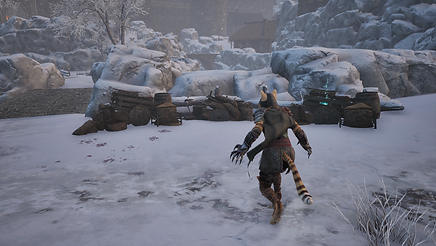

Villagers were dragged to the well for a blood sacrifice.
“After seeing the town outside of the manor in Tandar, this game is more gruesome than I thought.”
-Kristala Discord Member
Dual Process Theory
One technique to keep soulslike players engaged is to have emergent solutions to difficult encounters that players discover through play. This way, if they die, players see a tactical solution that will make their next attempt easier, and therefore they want to try again. It's another take on dual-process theory where players will first attempt an encounter using familiar, automatic play patterns, but after failure, they will take a more engaged, analytic approach.
A systemic way to create these encounters is to place attractors and affordances in the encounter space, but to not signify their use before the encounter. Here's an example:

The entrance to this camp doesn't offer any affordances that there might be a better approach.


Players can follow the trail of traversal elements to discover another entrance to the camp. This path allows players to bypass many of the enemies and get an aerial takedown on the camp's elite enemy, making the encounter much more forgiving.
However, as players progress through the camp, they see indications that there is another way to access this camp.
"I really liked the verticality, you could fight the enemies down below or sneak up from above. Reminded me of Batman Arkham [Asylum] or the Spiderman games."
-Playtester
Content Diffusion Patterns & Pacing


I divided the level into 30 activity blocks, each with a dominant activity type. Each block encompasses 2.5-4 minutes of gameplay. We expect players to die 3-5 times per session, and each death will set players back 2-4 minutes. This results in 1.5-2.5 hours of total gameplay for this level depending on playstyle.

Level flow chart broken down by activity type
In the level flow chart, notice how each activity type is always followed by a different activity type to keep player engaged. Exception: When the player first enters the manor house, we hit them with 2 back to back combat blocks to spike intensity. Also, when the player first exits the manor, we hit them with 2 back to back exploration blocks to give them some relief as they've just survived the level's most intense moments.
I also follow AAA engagement principles by requiring players to make micro decisions, such as button presses or path selections at least every 15 seconds.

"The atmosphere and horror build up around [the manor] was just so GOOOOOOD"
-Kristala Discord Member
Teaching Design Language Diegetically

I force players to use this log to reach this checkpoint at the start of my level. This teaches them that logs are for traversal.
Observant players may notice this log above them which is a foreshadowed route.


Which players recognize as a means to cross over the gully later on.
Finally, I reward players who understand this design language by hiding a valuable pickup on top of a rockfall debris field.

"I was sure there'll be a hidden item here. I was freaking sure!"
-MistaFiOth: soulslike streamer with 16+ million views.
As you can see from this streamer footage, players feel smart when they pickup on the design language and are rewarded for it.
What players are saying:
-Playtester
"I loved traversing the manor area, it was creepy and had a lot of corners where enemies could hide. Made you stay on the edge of your seat."
“Still love the manor in Tandar, can’t get over it.”
-Kristala Discord Member